

A free tier is where every honest pricing comparison starts, because it tells you what a tool costs at zero volume and what it withholds until you pay. Across our database of 114 AI media tools, 92 offer some form of free tier. Among the AI video generators specifically, 11 of the 14 recorded tools have one. The seven below are the ones worth your first tests.
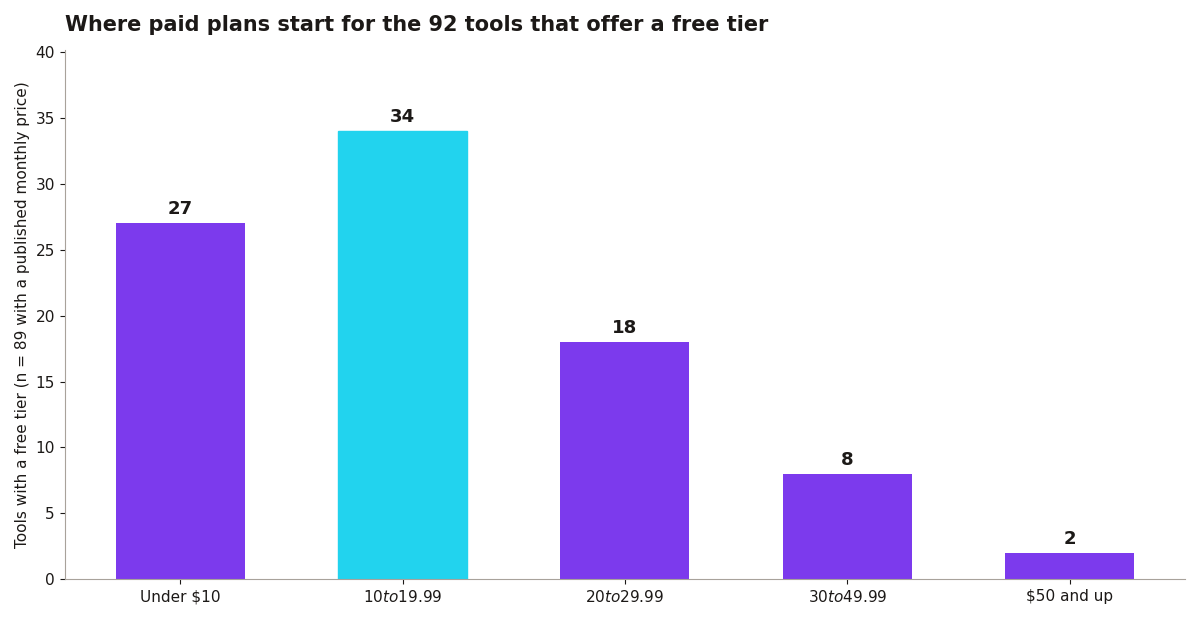
Where the paid rungs actually begin. Of the 92 tools with a free tier, 89 publish a monthly starting price, and the pattern is encouraging for anyone testing before they commit. Twenty seven start under $10 a month. The biggest band, 34 tools, starts between $10 and $19.99. Eighteen sit between $20 and $29.99, eight between $30 and $49.99, and only two start at $50 or more. The median starting price across the group is $13 a month. In other words, the jump from free to paid is usually a small one, which removes the usual excuse for skipping the free test altogether.
The seven free tiers worth testing. Veo 3 (Google AI Studio): free generations for testing, with native audio. The best free quality available. Kling: 66 free credits a day, enough for real experimentation. Pika: free tier with watermarked or limited generations. Runway: 125 one-time credits; not recurring, but enough to evaluate properly. Hailuo/MiniMax: free tier with character consistency features. Luma Dream Machine: free tier for image-to-video. Hedra: 300 free credits a month, character-focused generation.
How the video generators compare on price. The 11 video generators in the database that record a free tier publish paid starting prices from $9.99 to $35 a month, with most clustered between $10 and $15. That clustering is the real comparison result: once you have tested the free rungs, the paid decision is rarely about a dramatic price gap. It is about which model's output style fits your prompts, what the free tier withheld, and how the price behaves when your volume grows past the entry tier.
What free tiers withhold. Commercial rights (check each tool), resolution (often capped at 720p), and queue priority. Free users wait longer, export smaller, and in many cases cannot legally use the output for client work. Treat the free tier as a test bench, not a production plan. The moment a free output is headed for a client or a monetized channel, read the license line for that specific tool before you publish, because the database shows the terms vary tool by tool even inside the same category.
The other side of the ledger: tools with no free rung. Twenty two of the 114 tools in the database record no free tier at all. They are paid from the first generation, sometimes with a short trial, sometimes with nothing but a pricing page. That does not make them bad tools; several are category leaders that can afford to charge from day one. It does change how you evaluate them. With no free tier, your test budget is real money, so the comparison order flips: read the recorded pricing, the output ceiling, and the license terms first, watch the sample galleries second, and only then spend on a short paid test at the smallest tier. Never let a no-free-tier tool be the first one you try in a category, because you will have no baseline to judge it against.
How long a free test should last. A free tier answers three questions: does the model's style fit your prompts, does the export quality survive your delivery channel, and does the queue move fast enough for your deadlines? Most creators can answer all three inside twenty generations. Spread those generations across at least two days and two prompt styles, because a single lucky output proves nothing. If a tool offers daily credits, like Kling's 66 a day, use the rhythm; daily limits are a feature for evaluation, since they stop you from burning the whole test in one excited hour. When the three questions are answered, the paid step is a decision, not a gamble.
Test before you pay. Run the same prompt across three free tiers before paying for any of them. Quality differences are subjective; your prompt style will click with one model more than the others. Find that fit free, then pay for the winner. When you are ready to move up, run the paid tier through the Before You Pay checker so the per-video cost at your real volume is on the table before the card is. A free tier is a pricing comparison that starts at zero. The data says the first paid step is usually $10 to $20. Spend it only after the free tests have told you which tool earned it.